In preparation for submission to TMLR
Audited Surrogate Gradients for Efficient Model-Based Flow Control
With Stefania Fresca
University of Washington
Workshop version: Accepted to the Sim2Science workshop at NeurIPS 2026. Journal manuscript in preparation for Transactions on Machine Learning Research (TMLR).
The question
Accurate state prediction does not imply a faithful control Jacobian.
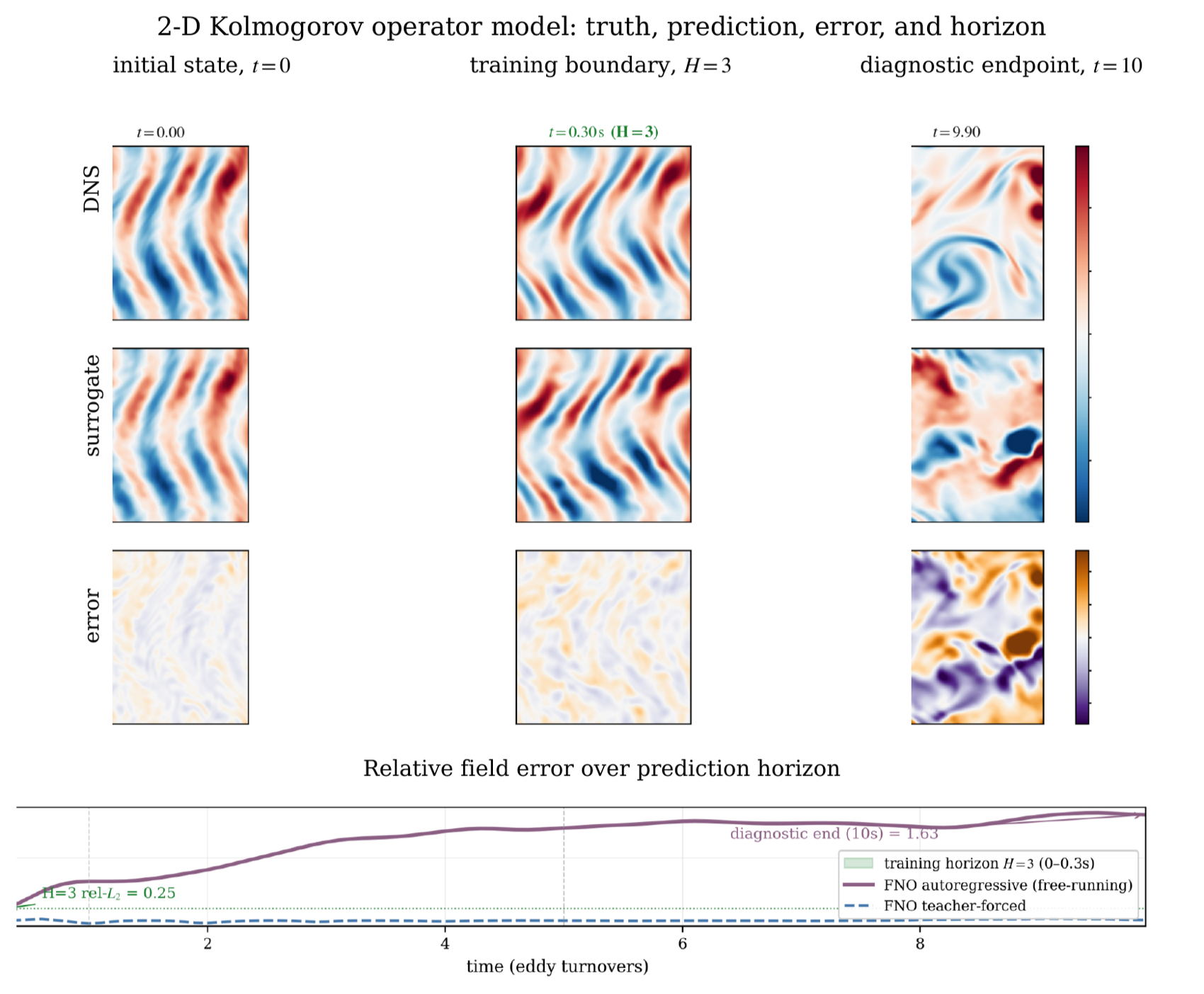
Neural surrogates can reduce the cost of trajectory optimization, but controller design depends on derivatives with respect to the action. These derivatives can be wrong even when one-step state errors are small.
I compare automatic-differentiation gradients from the surrogate with central finite-difference sensitivities from a high-fidelity solver on held-out states. A compact feedback law fitted to the measured gradient field initializes a neural policy, and an anchor penalty keeps optimization close to that law. Controllers are evaluated in the original solver across four test cases.
Perturb
Estimate action sensitivities with paired finite-difference DNS trajectories.
Audit
Compare gradient sign, direction, and magnitude across relevant horizons.
Distill
Fit a compact feedback law to the measured high-fidelity gradient field.
Refine
Initialize a neural policy from the feedback law and keep it close with an anchor penalty.
Validate
Evaluate closed-loop performance and falsification controls in DNS.
Physical test
The audited gradient identifies a useful feedback phase.
The local action gradient predicts a feedback phase that lowers the objective in direct numerical simulation. A falsification phase produces the opposite response, providing a controlled test of the inferred mechanism.
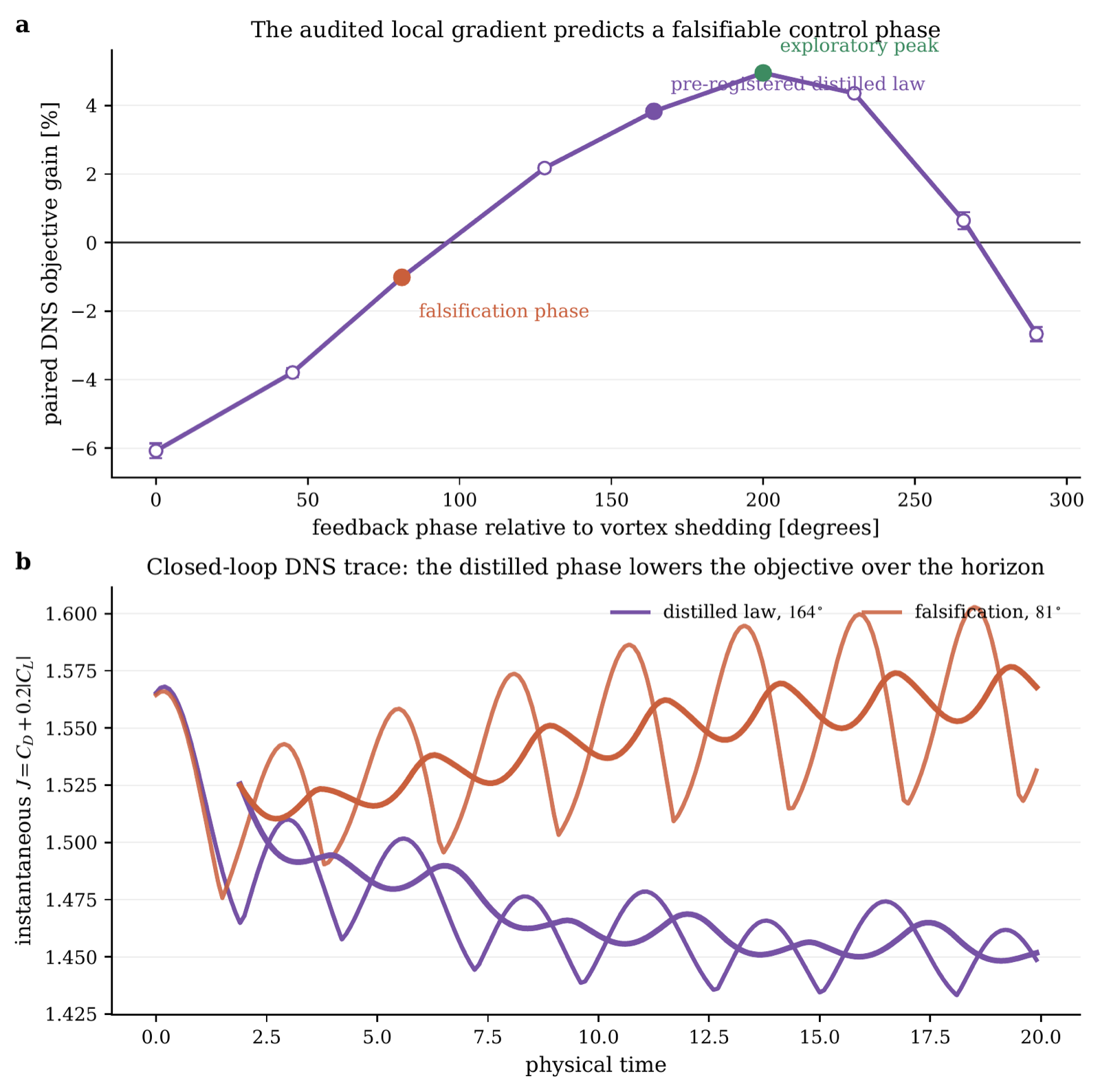
Prediction accuracy, action-gradient fidelity, and closed-loop performance are distinct properties. An audit is local to the sampled states and actions, so gradients must also be measured around the actions the deployed controller applies.